
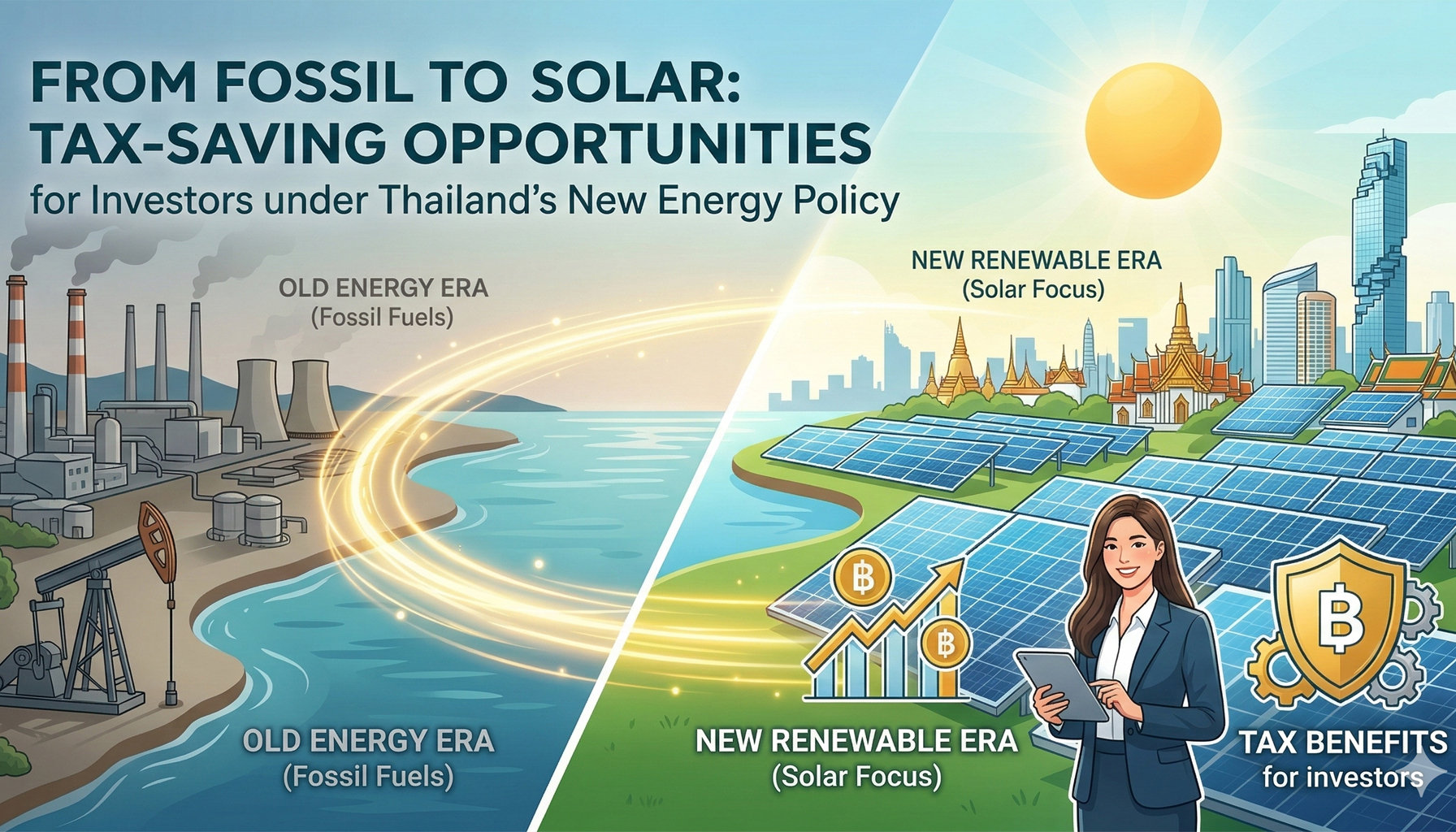
To accelerate the transition from fossil fuels to solar energy plan, aligned with Thailand’s goals on carbon neutrality and net-zero greenhouse gas emissions by 2050, the Thai government unveiled a new tax incentive measure. The corporate sector can benefit from an income-tax exemption equivalent to 50% of the investment amount in high-efficiency machinery or energy-saving equipment that carries a Level 5 energy-efficiency label, while the household sector can claim an income-tax exemption for Solar Rooftop installation costs of up to THB 200,000 per person.
To support this clean-energy transition, Thailand this month enacted the Royal Decree B.E. 2569 (2026) regarding the amendment of Revenue Code on Tax Exemption (No. 805). The decree provides two different income-tax exemption schemes for businesses and households. The two schemes target different taxpayer profiles and cannot be stacked on the same expense for the case of non-corporate taxpayers.
For the corporate sector, the takeaway is simple: Qualifying investments in certified energy-efficient machinery or energy-saving equipment may unlock a Corporate Income Tax (“CIT”) exemption equal to 50% of the investment amount, provided the relevant expenses are paid during 3 March 2569 to 31 December 2571. For example, if the qualifying expenditure is THB 1,000,000, the taxpayer may claim an tax exemption of up to THB 500,000, against CIT liabilities for companies. To qualify, the equipment must carry a Level 5 energy-efficiency label certified by the Department of Alternative Energy Development and Efficiency (DEDE) and the Electricity Generating Authority of Thailand (EGAT).
For the household sector, the government aims to make it easier for individuals to start adopting Solar Rooftop systems. Accordingly, individuals may claim Personal Income Tax (“PIT”) exemption based on the actual amount paid during 3 March 2569 to 31 December 2571, capped at THB 200,000 in total. Eligible expenses include equipment purchase and installation costs for a grid-connected rooftop solar system installed on a residential building. As this measure is designed as “starter support,” not as a recurring subsidy, the right can be used only once and is limited to one system upon a successful connection to the grid. The same solar rooftop expenses cannot be used again to claim the 50% income-tax exemption available for energy-saving equipment, whether in whole or in part.
A key condition for both incentives is that taxpayers must have verifiable tax documentation. In practice, this typically requires an e-Tax Invoice / full tax invoice issued by a seller that is properly registered in Thailand’s tax system. Moreover, the same expenses cannot be “double-claimed” under other tax incentive schemes, whether in whole or in part, including incentives under BOI, the competitiveness enhancement measures, and the EEC framework.
(Source: Royal Decree Issued under the Revenue Code on Tax Exemption (No. 805) B.E. 2569 (2026), issued on 2 March 2026)
Author’s Note:
The incentives under this Royal Decree offer new opportunities for taxpayers from its effective date. During the three-year incentive window, companies can optimize after-tax returns while structurally reducing future energy costs, allowing tax and cost efficiency to be achieved in parallel.
[Contact Person: Ms. Thirapa Glinsukon, Partner and Mr. Nattawat Wattanatornnan, Tax Consultant]