
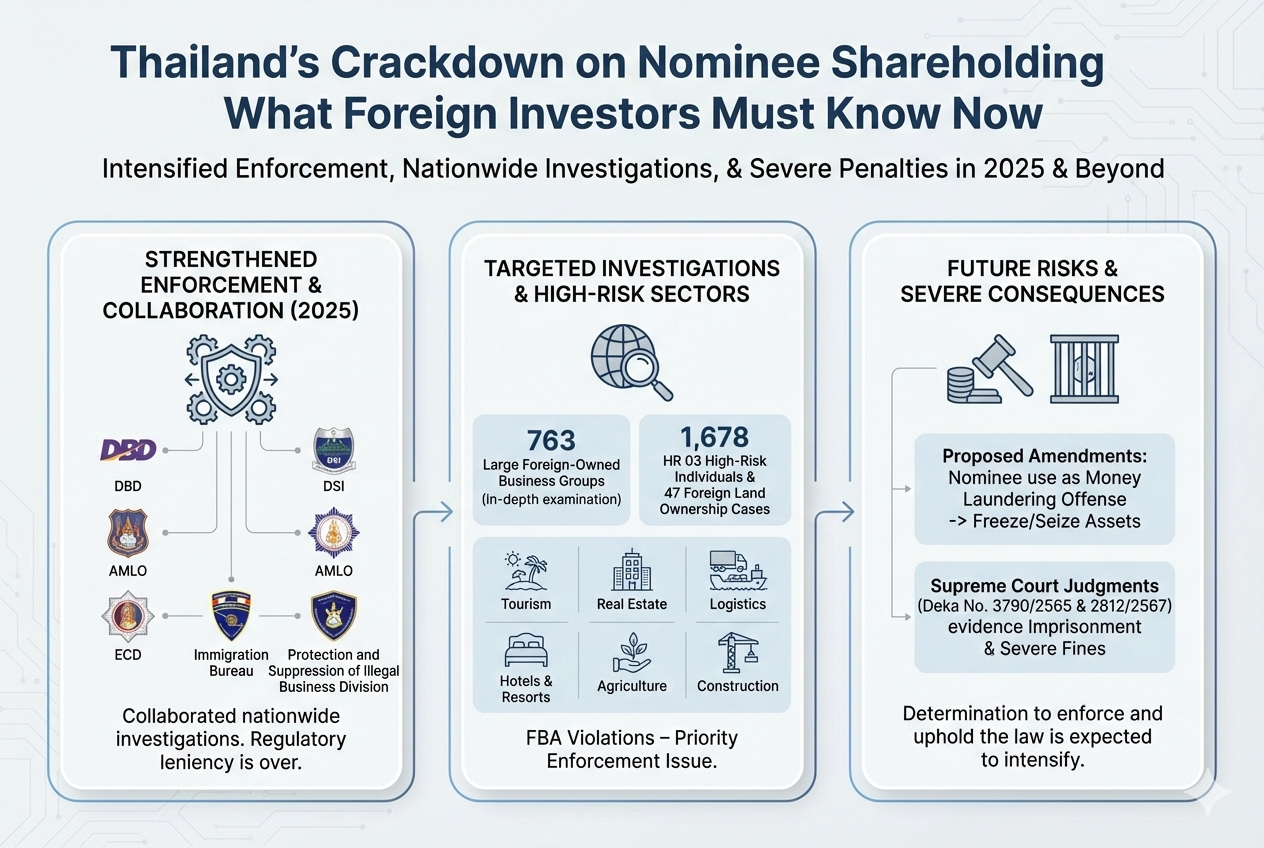
Thailand has strengthened enforcement against nominee shareholding, and pressure on foreign owned companies has never been higher. In 2025, relevant government agencies—including the Protection and Suppression of Illegal Business Division, the Department of Business Development (“DBD”), the Department of Special Investigation (“DSI”), the Anti Money Laundering Office (“AMLO”), the Economic Crime Suppression Division (“ECD”), and the Immigration Bureau of the Royal Thai Police-collaborated and shared information to fight nominee arrangements. The coordination of nationwide investigations, together with intensifying penalties, signaled that regulatory leniency is over.
So far, the authorities have conducted investigations into high risk legal entities, including an ongoing in depth, targeted examination of 763 large foreign owned business groups. In parallel, the authorities are reviewing 1,678 individuals classified as HR 03 high risk persons, as well as investigating 47 cases involving foreign nationals’ land ownership.
These investigations span six high risk sectors most commonly associated with nominee arrangements: tourism, real estate, logistics, hotels and resorts, agriculture, and construction, which were in violation of the Foreign Business Act B.E. 2542 (“FBA”) and are now being treated as a priority enforcement issue across multiple agencies. Newly proposed amendments could even classify nominee use as a money laundering offense, enabling regulators to freeze or seize assets linked to these arrangements.
Criteria for Identifying Investigation Targets:
- Foreign shareholders hold less than 50 percent of the shares;
- Foreigners have authority to act on behalf of the company, the company’s Articles of Association grant rights to foreigners in excess of those granted to Thai nationals, or the management or business operations appear irregular; and
- The business operates in one of the six sectors most commonly associated with nominee issues—namely tourism, real estate, logistics, hotels and resorts, agriculture, and construction
Author’s Note:
What Foreign Investors Must Do Right Away:
To stay ahead of enforcement and protect your operations in Thailand, foreign investors must take the following steps immediately:
1) Review your ownership structure;
2) Verify that Thai partners are genuine contributors; and
3) Explore legitimate and compliant alternatives under Thai law.
What can DRKI help you?
Our legal team provides strategic guidance to clients facing regulatory investigations, including matters involving nominee shareholding structures. With deep insight into Thailand’s evolving enforcement landscape, we deliver swift, practical, and solutions‑focused support. Our goal is to equip businesses with a clear understanding of their legal position and help them navigate government inquiries with confidence and clarity.
For more information, please reach out to the authors; Opor Dharmaroj (
visit www.drkilaw.co.th to find out more about our practice.
[Contact Person: Mrs. Opor Dharmaroj, Partner]