

On 2 June 2026, the Thai Cabinet approved the Second Protocol to amend the ASEAN Trade in Goods Agreement (ATIGA), whose objective is to facilitate trade, promote the movement of goods within the region, and reduce or eliminate import tariffs among member countries, most of which have been lowered to 0%.
The Upgraded ATIGA will enter into force within 18 months from the date of full ratification by all ASEAN Member States. Having been signed on December 1, 2025, the Protocol is anticipated to become effective on June 1, 2027.
The focal points in the Upgraded ATIGA would be the new Procured Exclusivity (PE) rule.
The ASEAN Free Trade Area (AFTA) Council in 2025 approved the negotiations to upgrade the ATIGA. This protocol introduces amendments to the existing ATIGA by adding six new chapters, including areas such as trade in humanitarian crises and trade and environment. It also revises eight existing chapters and one annex, while retaining three chapters and one annex, with the objective of modernizing the agreement to better reflect current trade practices.
With respect to the Rules of Origin, which are a key condition for claiming tariff preferences under ATIGA, the original ATIGA classifies goods into the following two main categories.
1) Wholly Obtained (WO)
This refers to goods that are wholly obtained or produced within a single ASEAN Member State, without the use of imported materials, whether from outside ASEAN or from other ASEAN Member States.
Typically, this category covers agricultural products, goods derived from animals raised within the country. It also extends to goods obtained or produced exclusively from these locally sourced materials, all of which are recognized as having originating status under ATIGA.
2) Non-Wholly Obtained (NWO)
In contrast to wholly obtained goods, non-wholly obtained goods are those that incorporate materials or components sourced from both domestic and foreign origins. As such, these goods are not produced entirely within a single ASEAN Member State. Common examples include automobiles, electrical appliances, and various consumer goods.
Despite the use of imported materials, such goods may still qualify as originating in a particular Member State where the key manufacturing or production activities take place, provided that one of the following criteria set forth in ATIGA is satisfied.
2.1 Regional Value Content (RVC)
This criterion measures the extent to which the value of a product is contributed by ASEAN Member States by comparing the regional value content to the Free on Board (FOB) price of the goods. The ASEAN content must be at least 40% of the FOB value.
2.2 Change in Tariff Classification (CTC)
This criterion considers whether the finished product falls under a different tariff classification at the four-digit level of the Harmonized System (HS) when non-originating materials are used in its production, in line with the specified conditions.
Under the Upgraded ATIGA, the Rules of Origin have been further enhanced through the introduction of a new criterion, known as Produced Exclusively (PE). This newly introduced rule allows goods to be considered as originating where they are produced in a Member State exclusively from materials and components sourced from ASEAN Member States, without the use of any non-ASEAN inputs in the production process.
The introduction of the PE criterion can be seen as a “fast track” for business operators, offering several key advantages:
- Greater sourcing flexibility is achieved by shifting the focus from a single ASEAN Member State to the entire ASEAN Region, allowing businesses to use materials from any ASEAN Member State while still qualifying for originating status.
- A reduced compliance burden for businesses sourcing materials within ASEAN, as there is no longer a need to undertake RVC calculation or assess CTC requirements.
- Lower the risk of retrospective tax reassessments, particularly in cases where cost calculations may be challenged or incorrectly determined.
Example: Production of UHT milk in Thailand using materials from Thailand and Malaysia
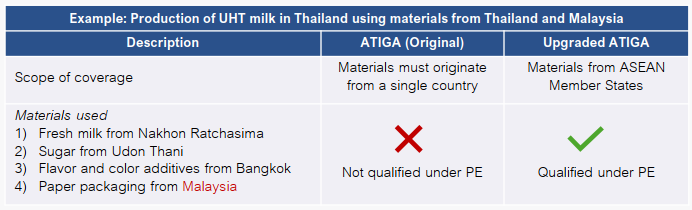
Author's Notes:
The Upgraded ATIGA reflects a shift toward more practical and business-friendly Rules of Origin that align with modern regional supply chains. In particular, the introduction of the PE criterion plays a significant role in reducing compliance burdens, saving time for procurement and accounting functions, and lowering the risk of post-clearance adjustments due to cost allocation errors. It also promotes more efficient utilization of ASEAN-origin materials within the region.
Written by Ms. Chotisa Chaiyanboon, Deputy Manager and Mr. Vorakarn Opanont, Tax Consultant
[Contact Person: Mr. Phongnarin Ratarangsikul | Partner]